
Health Testing
Simplified for people to find a puppy of any breed.
Understanding health screening and tests can be mind boggling for non-breeders. What do the tests mean? What are good and bad scores. Is health everything?
In any purebred breed there are predispositions for diseases. What does this mean? These are the diseases most likely to develop or be present in that breed. Does this mean mix breeds or street dogs won’t get these diseases? No, it only means you can better predict the diseases in a purebred dog than dogs with an undetermined parentage.
For some of these diseases there are some forms of testing available – some have specific genetic tests, for others we look at what the parents present with. If the parents do not present with the disease, it does not mean that they do not have the genes to pass on the disease, it only means that they do not present with the problem themselves.
English Springer Spaniels & Cocker Spaniels
| DESCRIPTION | TEST AVAILABLE / RESULTS |
|---|---|
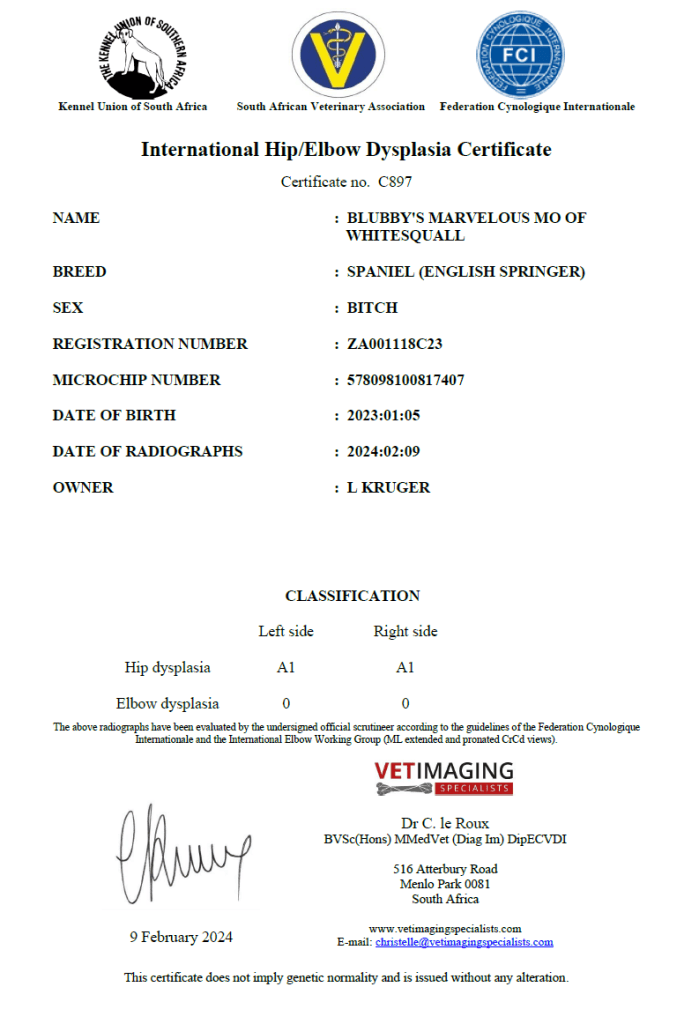
| Hip Dysplasia | HD and ED screening of the parents is recommended: These are X-rays of the hip and elbow joints, scrutinised by specialist radiologists and graded. In South Africa, the scoring system is A1-E2 per hip; A1 being the best/near perfect hip, A2 being a good hip, B1, B2, C1, C2, D1, D2, E1, E2 being a severely dysplastic hip. |
| Elbow Dysplasia | In South Africa, there are 4 possible scores: 0 indicates normal elbows 1-3 different grades of Elbow Dysplasia |
| Cataracts | Annual Eye Certificate by a SAVA Certified Veterinary Ophthalmologist |
| Glaucoma | Annual Eye Certificate by a SAVA Certified Veterinary Ophthalmologist |
| Progressive Retinal Atrophy (PRA) is a collective of genetic eye disorders that share similar symptoms, and there are numerous mutations that cause PRA in various canine breeds. | Annual Eye Certificate by a SAVA Certified Veterinary Ophthalmologist DNA Test [Clear, Carrier or Affected] |
| Entropion & Ectropion | Annual Eye Certificate by a SAVA Certified Veterinary Ophthalmologist |
| Epilepsy | None |
| Phosphofructokinase (PFK) deficiency, also known as “glycogen storage disease type VII”, is a glycogen storage disease where glucose-6-phosphate and fructose-6-phosphate accumulate in the muscle tissues and cause muscle cramping which can lead to fatigue, lethargy and exercise intolerance. Phosphofructokinase deficiency has been characterised in the English Springer Spaniel, Cocker Spaniel and Whippet. Symptoms present early in a puppy, within a few months. This is not a life-threatening disease, however, does impact on the quality of life of the individual. | DNA Test [Clear, Carrier or Affected] |
| Canine Fucocidosis (FUCO) is a lysosomal storage disease that is caused by the absence of α-L-fucosidas which results in a neuroprogressive disorder. Fucosidosis in English Springer Spaniels is observed between 18 months and 4 years and is fatal. | DNA Test [Clear, Carrier or Affected] |
| Allergies | None |
| Dyserythropoietic Anemia and Myopathy Syndrome (DAMS) is an early onset inherited condition, with mutations described in both Labrador retriever and English Springer Spaniel. The clinical symptoms can include muscle atrophy, pelvic limb weakness and regurgitation, with an early onset of anemia, megaesophagus, generalized muscle atrophy and cardiomyopathy observed in English Springer Spaniels. Other clinical signs may include difficulties opening and closing the mouth, difficulty in lapping water, as well as aspiration pneumonia, seizures, and chronic diarrhea. | DNA Test [Clear, Carrier or Affected] |
| Degenerative Myelopathy (SOD1A) is a late onset degenerative neurological disease of the spinal cord that is prevalent in many canine breeds. As the spinal cord degenerates, the canine will display clinical symptoms such as ataxia in the pelvic limbs. | DNA Test [Clear, Carrier or Affected] |
| Acral Mutilation Syndrome (AMS) is an inherited neurological disease affecting dogs. Clinical signs appear in young puppies (around 4 months of age) and presents as acral analgesia (insensitivity to pain), with or without sudden intense licking, biting and severe self-mutilation of the paws. As such, affected dogs may thus also present with severe, self-induced wounds of the feet such as toe amputations, loss of toe nails, and painless bone fractures. Affected dogs may also continue to walk without obvious discomfort due to their inability to feel pain, and are often also subject to secondary infections and the accompanying complications. | DNA Test [Clear, Carrier or Affected] |
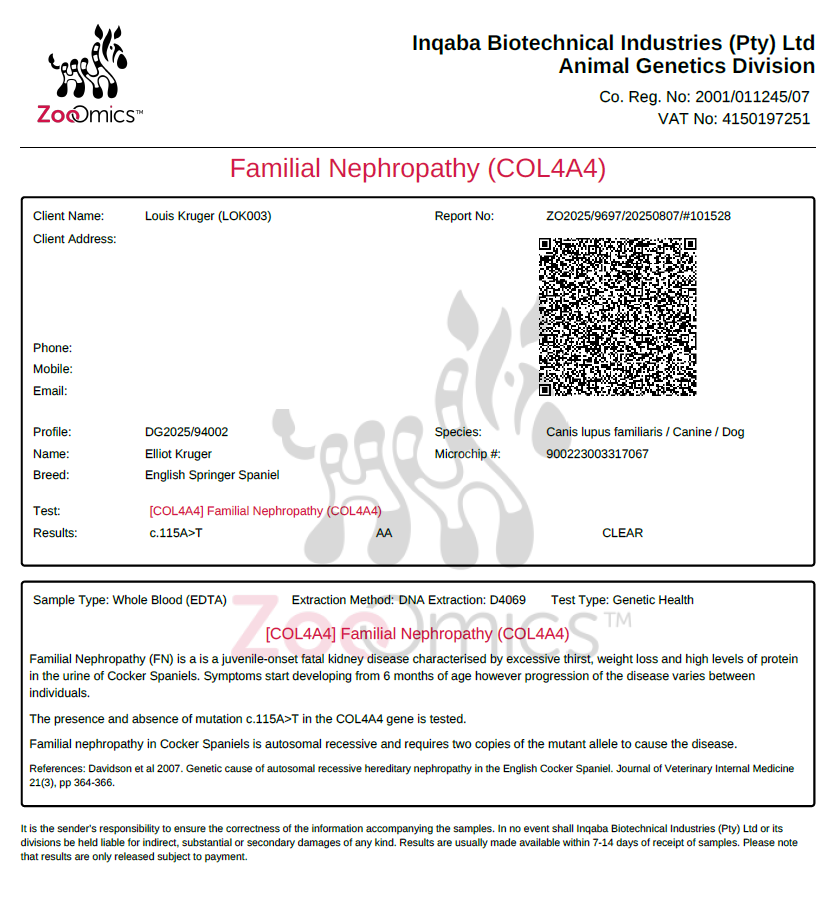
| Familial Nephropathy (FN) is a is a juvenile-onset fatal kidney disease characterised by excessive thirst, weight loss and high levels of protein in the urine of Cocker Spaniels. Symptoms start developing from 6 months of age however progression of the disease varies between individuals. The presence and absence of mutation c.115A>T in the COL4A4 gene is tested. Familial nephropathy in Cocker Spaniels is autosomal recessive and requires two copies of the mutant allele to cause the disease. | DNA Test [Clear, Carrier or Affected] |

Notes
- For testing eye disease all breeding (and also past breeding age) dogs need an annual eye certificate by a SAVA Certified Veterinary Ophthalmologist.
- In this eye consultation, the dogs are checked for the presence of disease in the eye. Some eye diseases are congenital, present at birth, some develop later in life, even past breeding age. Therefore, it is important to test well beyond breeding age to understand what diseases are in a pedigree.
- So apart from the diseases mentioned, all other screening is based on phenotype not genotype. This means the dog is evaluated based on the presence of the disease. Being clear does NOT mean that they can’t reproduce it in their pups.
- Other diseases like epilepsy are very difficult to predict. Even in diseases such as HD & ED breeder knowledge and understanding of pedigree is imperative.
- Remember the perfect dog of any breed is yet to be born.
- My responsibility as a breeder is to try and understand these diseases as much as possible to try and prevent reproducing them. Could we breed a problem? Absolutely!!

